
You know the moment.
You're almost to the contract stage with a huge prospect, but the first document they send isn't a draft contract. It's their security requirements. You start reading: data residency, air-gapped networks, a soup of compliance frameworks you've never heard of.
Most teams read that PDF and feel their stomachs drop. Not only did their deal just slow down, but they’re going to have to take time away from building features to meet security requirements they’ve never even considered. You should feel the opposite. It's a buying signal.
The largest AI contracts closing right now share one trait: the buyer runs the software in their own environment. Defense. Healthcare. Financial services. Critical infrastructure. These aren't niche verticals or edge cases, these companies represent the top of the market. They have budget. They have urgency. And they have a problem most AI startups haven't solved yet: delivering a product that works behind their firewall, on their infrastructure, under their control. That gap is your opening.
For buyers in regulated industries, on-prem isn't a preference. It’s a prerequisite. Without it, you never make it past a demo. The deals don't stall. They never start.
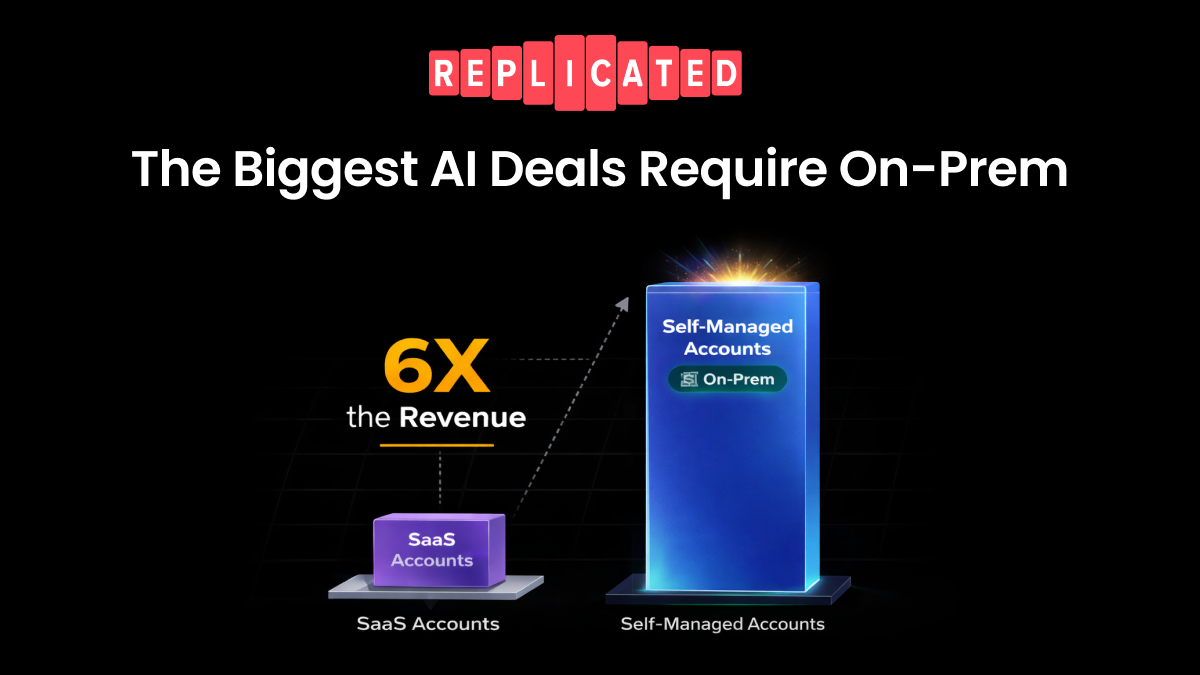
The numbers tell a clear story. Self-managed accounts generate 6X the revenue of their SaaS counterparts. And the trend is accelerating: 79% of ISVs report their on-prem business has grown, not shrunk, over the past year.
This runs counter to everything you've heard. You've spent the last decade building for the cloud and watching everything move to SaaS. The emergence of AI changes that calculus. Models trained on proprietary data, inference pipelines processing sensitive documents, RAG systems indexing internal knowledge bases: the risks are too high for your most valuable customers to accept a multi-tenant solution.
Your buyer knows this. Their CISO knows it.You need to know it, too. The highest-value segment of the market isn't asking "can we use your AI service?" They're asking "can we host your AI product in our environment?" The startups that answer yes are the ones closing those large enterprise deals.
That's where a platform like Replicated comes in. You ship your containers and Helm charts. Replicated gets them running in the environments where every network hop needs approval and every certificate gets validated against an internal CA. We provide what you need for installation, updates, support tooling, and license management. It’s the full delivery stack, built so your team can stay focused on the features that make you unique.
How AI Companies Are Closing Faster
Companies like H2O.ai, Pixee, and Reflex are already signing big contracts deploying into customer-controlled environments. The ones closing fastest have figured out the delivery infrastructure.
H2O.ai spent years watching the same pattern: a government agency or bank would agree to pilot their AI platform, then disappear into a six-month hardware procurement cycle. By the time iron hit the rack, buyer momentum was gone. So they flipped the model. They built a pre-configured 2U appliance hosting their software on the Replicated Embedded Cluster. It ships as a single unit. No procurement delays. No waiting on a dozen infrastructure teams. Just rack it, plug it in, and start running models. "Instead of waiting 6 months for the customer to procure hardware for a POC, we can deliver them something quickly," says Tom Kraljevic, VP of Engineering. The air-gapped environments that once stalled deals became H2O's fastest path to production.
Pixee builds AI that acts as an automated security engineer, fixing vulnerabilities before they ship. When a large global financial institution wanted to deploy Pixee's tools internally, the environment was anything but simple: all internet traffic routed through a proxy, every certificate validated against an internal CA, SELinux enforced across the cluster, and a ticket-based IT team halfway around the world. Deployments took weeks of back-and-forth. Using Replicated, Pixee cut that to 30 minutes. "We use Embedded Cluster where it fits and Helm where it's needed," says Brian Doyal, Staff Software Engineer. "Having the platform around both gives us the visibility to succeed in any enterprise environment, regardless of what the customer throws at us." A 25-person startup now closes deals in the most locked-down environments as fast as their largest competitors.
Reflex builds an AI-powered app builder that lets teams create full-stack internal applications entirely in Python. When Fortune 500 prospects started asking for self-hosted deployments, the sales team had no good answer. They "danced around" on-prem because Reflex had no repeatable way to deliver it. Only one engineer on the team knew infrastructure. Building it in-house would have taken months. Using Replicated, they launched a production-ready self-hosted workflow in weeks. "Within three months of us getting on Replicated, our sales team was actually able to pitch self-hosted confidently. We took one of our contracts from a five-figure deal to a six-figure contract. That was massive for us," says Simon Young, Engineer at Reflex. On-prem now makes up more than half of Reflex's total ARR. With their current pipeline, it could reach 80%.
The Revenue You're Leaving on the Table
Every one of these companies could have stayed SaaS-only. They would have shipped faster, supported fewer edge cases, and kept their architecture simple. They also would have left their most valuable deals on the table.
GitGuardian can directly tie on-prem customers to revenue growth. Pixee competes for deals against vendors with ten times their 25-person headcount. Reflex took a contract from five figures to six and now gets more than half its ARR from on-prem.
With AI, the data is almost always too sensitive to leave the customer's network. That makes on-prem the revenue opportunity, not a footnote to it.
Start Winning Enterprise AI Deals
Your peers are already doing this. If you're evaluating how to bring your AI product to enterprise buyers who need it running in their environment, request a demo to see how Replicated handles the delivery infrastructure so your team can stay focused on the product.